AMELIA EARHART IN TREPASSEY

ARCHIVAL MOMENT

June 17, 1928 

Amelia Earhart, June 14, 1928, Trepassey, Newfoundland

As a passenger on the Friendship, (Fokker F7 airplane) Amelia Earhart, the first woman to hop the Atlantic, flew from Trepassey, Newfoundland, to Burry Port, Wales, on June 17, 1928.

The Friendship and crew successfully landed in Newfoundlandon June 5 only to encounter gales or fog for days that prohibited their takeoff forEurope.

Earhart Arrives in Trepassey, June 5, 1928

···· The Friendship circled Trepassey twice before putting down in the choppy water of the harbor after a flight of 4 hours, 24 minutes. As the big monoplane taxied slowly toward the small cluster of houses on the eastern shore that was the town of Trepassey, dories full of men whirling ropes (Amelia called them maritime cowboys), each evidently hoping to guide them in, surrounded the Friendship, …

The town magistrate, Fred Gill, and his two sons, waiting near the monoplane in a dory, secured the honor of giving Amelia and Bill Stultz a ride to the dock. Slim Gordon came later, after tending to the plane.

The children of Trepassey, who had been watching and waiting at the windows of the convent school facing the harbour, ran down to the shore en masse. Amelia “had a vision of many white pinafores and aprons on the dock,” and was under the impression that school had let out early so that the children could greet them. In fact the children had simply fled without permission for which they were made to stay late.  She went up and visited with the children later at the convent school; the nuns were scandalized by the sight of a woman in pants.

One of the Telegrams that was sent to Amelia Earhart in Trepassey from a friend George, knowing that Amelia had not packed a change of clothing wired:

“SUGGEST YOU GO INTO RETIREMENT TEMPORARILY WITH NUNS AND HAVE THEM WASH SHIRT ETC –STOP”

It was arranged that the three fliers would spend the night at a small frame two story house with attached general Store belonging to Richard (Richie Dick)  and Fanny Devereaux …. Mrs  Devereaux too at first sight of Amelia in her “breeks” and boots was “quite overcome, and felt her to be sure I was present in the flesh.”

The Deveraux children,  among them,  a young girl  who was to grow up to be  Sister Theophane Curtis of the Presentation Congregation,  the daughter of Fanny Deveraux from a previous marriage moved from their family home to live with relatives.

DEPARTURE FROM TREPASSEY  - June 17, 1928

The team left Trepassey Harbor, Newfoundland, in a Fokker F7 on June 17, 1928, and arrived at Burry Port,Wales approximately 21 hours later, a distance of more than 2,010 miles (3,235 kilometers), in 20 hours 49 minutes. With Miss Earhart were Wilbur Stultz, pilot, and Louis Gordon, mechanic.

When the crew returned to the States, they were greeted with a ticker-tape parade inNew Yorkand a reception held by President Calvin Coolidge at the White House. From then on, flying was the fixture of Earhart’s life.

The experience in Trepassey might have been the inspiration for Earhart in the 1930’s  to design  a line of “functional” women’s clothing, including dresses, blouses, pants, suits, and hats, initially using her own sewing machine, dress form, and seamstress.  She photographed well and modeled her own designs for promotional spreads.

Recommended Reading: Earhart, Amelia. 1928. 20 Hrs., 40 min.: Our Flight in the Friendship. G.P. Putnam’s Sons:New York. (Reprinted in 2003 by National Geographic Adventure Classics:Washington.)

Recommended Website:  The official Website of Amelia Earhart:  http://www.ameliaearhart.com/

Forgery and Romance and Boston Connections

ARCHIVAL MOMENT

June 15, 1880

Hall Ceiling Painted by Pindkowsky, Government House

On June 17, 1880, the Carbonear Herald a local Newfoundland newspaper reported on the conviction of  Alexander Pindikowsky, a young artist and fresco painter, convicted for forgery. He was sentenced on June 15, 1880 to fifteen months at her Majesty’s Penitentiary.

The St. John’s newspaper, The Royal Gazette reported:

 “Pindinkowsky was ordered within five days of his release to quit the country (Newfoundland) for life, in default of which, on his return to the country at any time, he is to receive further imprisonment.”

Pindikowsky  (also Pindikowskie) arrived in Newfoundland in 1879 as a professional artist and fresco painter. He was hired by the Anglo American Telegraph Company to give art instruction to interested employees and their wives at Hearts Content Cable Office.

He was arrested on March 10, 1880 and charged with attempting forge two cheques in the name of E. Weedon, Esq. of Hearts Content, TrinityBay.

The Polish artist’s talents as a fresco painter were brought to the attention of the authorities at the Penitentiary and they were soon put to official use, in return for a remission of five weeks on his sentence. He was set to work designing and painting frescos, to relieve the drabness of the state rooms of Government House.

Governor John Hawley Glover (1876-1885) was so delighted with the frescos that he suggested to Prime Minister William Whiteway that the prisoner Pindinkowsky also decorate the ceilings of the two legislative chambers of the Colonial Building.  Seeing an opportunity the Presentation Sisters at Cathedral Square inSt. John’s who were in the process of working on their chapel and drawing room invited the talents of the young artist.

Each day Pindinowsky was brought from the penitentiary to his place of work until the frescos were complete.

It could be said that this is one of the first documented cases of  a prison rehabilitation program in Newfoundland and Labrador.

ROMANCE IN GOVERNMENT HOUSE

Researcher and historian, John O’Mara in his research on Government House in St. John’s discovered that Pindikowsky was also a romantic. In his research he discovered the face of a woman subtly painted into the ceiling of government house.  Some believe her to be one of the maids at government house.  She could possibly be Ellen Dormody the mother of Pindikowsky’s first child, Johanna Mary Ellen Pindikowskie, who was baptized at the Roman Catholic Cathedral (now Basilica) on May 1, 1882.

It is clear that Pindikowsky banishment from the country was withdrawn, he decided to stay in Newfoundland. In 1882 he was advertising his services in a local newspaper, as a fresco painter.

The Athenaeum, established in 1879 with it’s 1,000 seat theatre, that was central to much of the musical activity of the city hired him. He painted some very fine murals on the interior walls of the building. Unfortunately the theatre and his work were destroyed in the Great Fire of 1892.

Pindikowsky left St. John’s for the ‘Boston States’ in approximately 1882  followed a year later by Ellen Dormody. She is recoded as travelling from St. John’s to Boston on the SS Colan (or Coban) in 1883.

Life in Boston was unsettled they fist settled in Malden, Mass in 1885 where he is listed in the city directory as a painter then Brockton, Mass, in the city directories of 1887, 1888 and 1889, back to Malden for 1890, then in Newport, RI where he was listed in the city directory as a painter in 1897 and later back in Brockton, Mass.

It appears that he died between 1887 -1906.  His wife is listed in the  Brockton city directory as a nurse and a widow in 1906.

Ellen Dormody the wife of Pindikowsky would have felt very at home in the Boston area. The Commonwealth of Boston census for 1885 reports that 2851 Newfoundlanders had settled in the city and surrounding towns. That number had grown to 7,591 Newfoundlanders by 1895.  The census for Boston in 1915 reports that 13,269 residents of the Boston area claimed Newfoundland  as their place of birth.

Boston_Bruins_logoThe ‘Boston States’ and  Newfoundland  have many connections.

Go Bruins Go. !!!


Recommended Website:  http://www.heritage.nf.ca/govhouse/govhouse/tour2.html

Recommended VisitTo see the work of Alexander Pindikowsky both Government House and Presentation Convent are available to the public by appointment.  TheColonialBuilding is undergoing extensive renovations and is closed.

Recommended Archival Collection:  At the Rooms Provincial Archives read The Carbonear Herald, this paper carried domestic and foreign news, fishing and shipping news, legislative proceedings, religious news, advertisements, serial fiction and poetry. [1879-1882] Original and microfilm

(Thanks for additional research notes from Chris Morry)

What is a ‘blue drop’ ?

What is a ‘blue drop’? 

Holly Hogan and Allan Byrne, The Blue Drop.

Holly Hogan and Allan Byrne, The Blue Drop.

Summer Concerts on the Hill, a summer series of music hosted by National Historic Sites at the Signal Hill Visitor Centre Theatre will feature on Tuesday, June 11 at 7:00 p.m.   Allan Byrne and Holly Hogan.  Known locally as ‘The Blue Drop’ this singer/song-writer duo from St. John’s, combine their unique styles and beautiful harmonies with Allan’s intricate guitar arrangements on a wide range of folk country jazz and originals.

$15.70 Adults – $6.30 Students/ (6-16).

What is a ‘blue drop’?

Blue drop: the sea; an area of open water in an ice-field. (Dictionary of Newfoundland English)

Take time to listen:  http://www.cbc.ca/performancehour/2013/02/04/rod-caines-holly-hogan-and-allan-byrne/

For more information Call 772.5367 or visit www.facebook.com/SignalHillNHS for more information.

12,000 residents of St. John’s homeless

ARCHIVAL MOMENT

June 9, 1846

St. John’s previous to the fire of June 9, 1846

The origin of the fire, which broke out on  June 9, 1846, in St. John’s, has generally been attributed to the carelessness of a cabinet maker who lived on George Street.

By 7:00 p.m., when the fire had finally run its course, over 2,000 buildings had been burned and about 12,000 people, or 57 per cent of the town’s total population, left homeless. The total amount of property loss was estimated at £888,356.   Altogether, there were three casualties: one soldier died as a result of the demolition ordered on Water Street; one citizen collapsed while attempting to carry his possessions to safety; and one prisoner died in his cell when the gaol burnt. A few days after, two labourers clearing away ruins were killed by a falling wall.

Homeless Seek Shelter

On June 10, 1846 many of the 12,000 refugees from the fire could be found in make shift tents in this neighborhood (Fort Townsend) now the site of The Rooms. Others found shelter on the grounds of the new R.C. Cathedral (now Basilica) that was under construction, others in the area now called Bannerman Park on Military Road.

Recommended Reading: The Great St. John’s Fire of 1846 by Melvin Baker (c)1983 Originally published in the Newfoundland Quarterly, vol. LXXIX, no. 1 (Summer 1983) http://www.ucs.mun.ca/~melbaker/1846fire.htm

Recommended Archival Collection at the Provincial Archives in the Rooms:  MG 50.2:  Map of St. John’s, Newfoundland, showing all the buildings erected since the fire of the 9th of June 1846 from actual survey (MG 50.2)


Sacred Newfoundland Ground in France

ARCHIVAL MOMENT

June 7, 1925

Photo Credit: NA 3106; Opening of the Newfoundland Memorial Park, Beaumont Hamel, France

Of the five memorials established in France and Belgium in memory of major actions fought by the 1st Battalion of the Newfoundland Regiment, the largest is the thirty hectare site at Beaumont-Hamel, nine kilometres north of the town of Albert. This site commemorates all Newfoundlanders who fought in the Great War, particularly those who have no known grave. The site was officially opened by Field Marshal Earl Haig on June 7, 1925.

Shortly after the Great War, the Government of Newfoundland purchased the ground over which the 1st Newfoundland Regiment made its heroic advance on July 1.

Much of the credit for  this and the other memorials is due to (Reverend) Lieutenant Colonel Thomas Nangle, a Roman Catholic priest from St. John’s who, as Director of Graves Registration and Enquiry and Newfoundland’s representative on the Imperial War Graves Commission, negotiated with some 250 French landowners for the purchase of the site. He (Father Nangle) had a leading part in planning and supervising the erection, at each of the five Newfoundland Memorials sites in Europe, of a statue of the noble caribou, the emblem of the Regiment, standing facing the former foe with head thrown high in defiance.

The landscape architect, who designed the sites and supervised their construction, was Mr. R.H.K. Cochius, a native of Holland living in St. John’s, Newfoundland. The caribous were the work of the English sculptor, Basil Gotto. He also executed the statue of the “Fighting Newfoundlander,” which Sir Edward Bowring gifted to the people of St. John’s.

Recommended Reading:  Soldier Priest: In the Killing Fields of Europe Padre Thomas Nangle Chaplain to the Newfoundland Regiment WWI by Gary Browne and Darrin McGrath

Recommended Archival Collection:  Explore the many archival fonds (collections) that make reference to Beaumont Hamel at the Provincial Archives in the Rooms.  The collection includes hundreds of photographs.

Recommended Web Site: Distinguished Service: the Royal Newfoundland Regiment in the Great War, this exhibition documents the lives and experiences of the province’s soldiers and aims to encourage interest in research on the Royal Newfoundland Regiment. Located on level three at The Rooms, the exhibition focuses on the World War I service records of the Regiment, available at the archives on microfilm for the first time in this Province. http://www.therooms.ca/regiment/part1_entering_the_great_war.asp


THE “TOWN CLOCK”

ARCHIVAL MOMENT

June 1, 1859

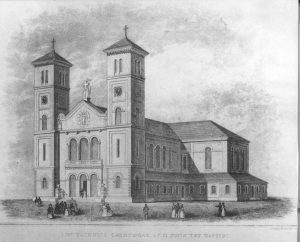
Basilica 1841On June 1, 1859 the talk in St. John’s was all about the installation of a ‘Town Clock’ and ‘Sundial’.   The “town clock” was being installed in the East Tower of the Basilica Cathedral and the “sundial” in the West Tower.   For the residents of St. John’s the installation was significant. The “town clock” was a symbol of self confidence, a symbol of permanence.

In 1859 a town clock was considered one of the principal characteristics of a town. Could you really have the status of a town without a town clock?

In St. John’s, a comparable installation in modern times would have been the installation of the first escalator in the Old Woolworth’s Building.  This new contraption signaled that St. John’s was taking on the trappings of a modern city!!

The “Town Clock” that was being installed was manufactured by Borrel of Paris, and boasted a dial in enameled lava. In the tradition of the town clocks of the day, it was not a clock to be “watched” but rather designed to be “listened” too.  Residents of the town would listen and on the hour and half-hour, as the new clock struck the great bell (the Bourdon) it would sound out.  There are reports that when the clock struck it could be heard for miles around even as far away as Torbay.   (The word “clock” comes from the same root as glocke, the German word for bell.)

In the “west tower” the sundial was being installed primarily for aesthetic balance. The sundial is the most ancient instrument for measuring time. Before the invention of mechanical clocks mounted on towers, “sun clocks” were the only instruments used to indicate the public time.

In 1954, the mechanical works of the clock were converted to an electrical system, and a new dial was installed.  The ‘sundial was removed.

In 2009 two new clocks were installed in the towers of the Basilica replacing the original clock and sundial.

Recommended Website: Take a virtual tour of the Basilica. http://www.thebasilica.ca/index.cfm?load=page&page=186


Portuguese present Fatima statues

ARCHIVAL MOMENT

May 27, 1955


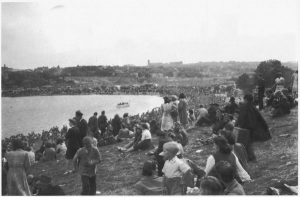
It is estimated that  four to five thousand Portuguese Fishermen carried the Fatima statues through the streets of St. John's .

It is estimated that four to five thousand Portuguese Fishermen carried the Fatima statues through the streets of St. John’s .

One of the highlights of the 100th Anniversary celebrations of the Basilica – Cathedral of St. John he Baptist in St. John’s in 1955 was a parade of four – five thousand Portuguese fishermen from the “White Fleet” who marched through the city of St. John’s on  May 27, 1955.

The fishermen walked in procession from the waterfront to the Basilica –Cathedral and presented a gift in the form of Our Lady of Fatima, comprising a group of nine statues, of poly chromed and gilt plaster.

The statues were presented to Archbishop Patrick J. Skinner of St. John’s, by Reverend Father J. A. Rosa, chaplain of the Portuguese fleet, on behalf of the officers and crews of the fleet, and the people of Portugal.   The grotto  where the statues were placed is located under the west gallery in the Basilica Cathedral. 

Only two other pieces of public art celebrate the presence of the Portuguese in Newfoundlandand  and Labrador.

The statue of  Gaspar Corte-Real Portuguese navigator – he reached Terra Nova (Newfoundland)  in the 15th century. This statue was unveiled on May 1965 in front of Confederation Building in St. John’s.  It was a gift from from the Portuguese Fisheries Organization as an expression of gratitude on behalf of the Portuguese Grand Banks fishermen for the friendly hospitality always extended to them by the people of Terra Nova.

The most recent installation of public art to celebrate the history of the Portuguese in Newfoundlandare the series of murals located on Duckworth Street.  (near the site of the  Sheraton Hotel) The murals depict scenes from towns in Portugal.

Recommended Reading: Port O’ Call, Memories of the Portuguese White Fleet in St. John’s, Newfoundland, by Priscilla Doel (Institute of Social and Economic Research, Memorial University of Newfoundland, St. John’s, 1992).

 Recommended Website:  Watch and listen as  the Portuguese carry the Fatima Statues to the Basilica Cathedral.   http://www.museevirtuel-virtualmuseum.ca/sgc-cms/expositions-exhibitions/basilique-basilica/assets/year_of_joy.html